Frequently Asked Questions About Guardrail
Posted by Audrey Hood on May 20th 2026
In facilities, there are often many moving pieces, workers grabbing inventory, forklifts moving product, equipment on the go.
When there’s a lot of movement, but not a lot of separation between moving machinery and people, accidents can happen. Guardrails provide a physical barrier that can soften the blow for collisions. Find out more about these solutions below.
Common Guardrail Questions
What is guardrail in industrial or warehouse settings?
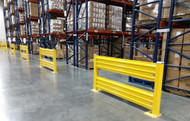
In industrial or warehouse settings, guardrail is a fixed structure designed to protect people and equipment from hazards. Guardrails, typically being bright yellow, are found along walkways, machinery, and loading areas to provide protection against collisions.
What is a guardrail system used for?
A guardrail system is used to create protective barriers that are used as a separation between humans, equipment, and machines, which reduces the risk of injury and damage. These structures can define pedestrian walkways, highlighting safe zones in facilities.
How do guardrails improve workplace safety?
Guardrails improve workplace safety by providing a physical barrier between workers and potential hazards. In warehouses where there’s moving equipment such as forklifts and pallet jacks, guardrails create a barrier to soften the blow if there were to be a collision.
What is the difference between a guardrail and a handrail?
The main difference between a guardrail and a handrail is that guardrails are designed to protect against hazards by acting as a barrier. A handrail provides support and stability for people, and is often found on stairs or ramps.
What are the main components of a guardrail system?
The main components of a guardrail system consist of vertical column posts, horizontal rails, and base plates or anchors that secure the system to the floor.
Why are guardrails important in warehouses and facilities?
Guardrails are important in warehouses and facilities as they can prevent accidents, equipment damage, and support safer environments. In high-traffic areas, guardrails create boundaries to reduce worker and moving machinery accidents.

OSHA, Safety & Compliance Questions
What height should a guardrail be?
A standard guardrail should be about 42 inches high. These dimensions can change depending on the application.
How strong does a guardrail need to be?
Standard Warehouse Guardrails need to be able to withstand a 10,000lb impact at 4mph. This ensures that they can be a trusty barrier in the event of impact.
Are guardrails required in warehouses?
Yes, oftentimes guardrail is required in warehouses with fall hazards or moving equipment. These help facilities meet safety requirements to protect workers and infrastructure.
What are the most common guardrail safety violations?
The most common guardrail safety violations include missing or damaged components, improper height, and unsecured posts.
Do guardrails need to be inspected regularly?
Yes, guardrails need to be inspected regularly to ensure that they are safe and effective. Routine inspections ensure that any damage or loose components can be addressed to ensure structural integrity.
Warehouse & Industrial Use Questions
Where should guardrails be installed in a warehouse?
Guardrails should be installed in areas where there is risk for collisions, falls, or interactions between people and machines. Guardrails can often be found along walkways, near loading docks, around machinery, and near racking.
Why are guardrails used around racking and equipment?
Guardrails are used around racking and equipment to protect them from moving machinery such as forklifts. Impacts can weaken the structural integrity of racking and can damage equipment. This ensures that the first impact from machinery will hit a guardrail instead of rack or equipment in the warehouse.
How do guardrails protect against forklift accidents?
Guardrails protect against forklift accidents by creating a barrier between the forklift and people or infrastructure. By reducing the risk of collision, forklifts are separated, and collisions go through the guardrail first.
Do guardrails protect people, equipment, or both?
Guardrails protect both people and equipment. These structures are set up by pedestrian walkways or around equipment, protecting them from moving machinery.
What areas in a facility need guardrails the most?
Areas in a facility that need guardrails the most include high traffic areas. This can include around racking, mezzanines, loading docks, aisle ends, and entry points.
Can guardrails improve traffic flow in a warehouse?
Yes, guardrails can improve traffic flow in warehouses as they create clearly defined paths for forklifts and pedestrians. This can minimize confusion as to where the flow of traffic should be.

Types & Design Questions
What are different types of guardrails?
There are several types of guardrails that can be used in industrial and warehouse settings. Different types include single rail and double rail guardrails, heavy duty guardrails, and pedestrian safety barriers.
What is the difference between single rail and double rail guardrails?
The difference between a single rail and double rail guardrail is the level of protection that they provide. Single rail guardrails have one horizontal rail while double guardrails have two rails for additional strength.
What materials are guardrails made from?
Guardrails can be made from materials like steel, aluminum, or polymer to provide high impact resistance.
Can guardrails be customized for different layouts?
Yes, guardrails can be customized for different layouts and applications. These can be configured to meet your space constraints and can be modular to be reconfigured over time.
Cost & ROI
How much do guardrails cost?
The cost of guardrails depends on the material, size, and layout. In industrial applications, guardrails can be priced by linear foot, and prices vary by design and project scope.
What factors affect the cost of guardrail systems?
Factors that affect the cost of guardrail systems include the type of material, height, configuration, number of posts, installation, and permits. Other customized features can also affect the overall pricing.
Are guardrails worth the investment?
Yes, guardrails are worth the investment. These reduce the risk of people or other infrastructure getting hurt or damaged, which would lead to significant costs. By being able to prevent one major accident makes guardrail worth it.
How much damage can guardrails prevent?
Guardrail can prevent a substantial amount of damage between moving machinery and people or equipment. In warehouse environments, moving machinery can affect structural components for racking, equipment, inventory, downtime, and injuries.

Installation & Layout Questions
How are guardrails installed?
Guardrails are installed by securing vertical posts to the ground, and then positioning horizontal rails in between.
How long does it take to install guardrails?
The installation time for guardrails is typically quick, but it depends on the project application as smaller, less complex projects move quicker than larger, more complex projects.
Do guardrails require floor anchoring?
Yes, guardrails require floor anchoring as these need to be stable in case of impact.
Can guardrails be removed or reconfigured?
Yes, guardrail systems can be removed or reconfigured, offering flexibility to facilities with changing layouts or growth.
What should be considered when designing a guardrail layout?
When designing a guardrail layout, you should consider the flow of your facility. This can help you determine where guardrails should be installed to promote walkways. If there are high-risk zones where rack ends are installed, dock areas, or intersections, this can also be beneficial to have guardrails.
Performance & Durability
How strong are industrial guardrails?
Industrial guardrails are designed to hold up against significant force and act as a barrier to heavy machinery. Commonly, guardrails are able to withstand a 10,000lb impact at 4mph, protecting your setup.
Can guardrails stop a forklift?
Guardrails are engineered to deflect forklifts, reducing damage and injury. By acting as a buffer, guardrails may not “stop” forklifts but minimize the damage that they cause.
How long do guardrails last?
Guardrails are built for long term use, and lifespan can be affected by types and frequency of impacts.
What happens if a guardrail is damaged?
If a guardrail is damaged, it should be inspected and repaired or replaced to ensure that it can withstand another hit.

Safety Questions
What’s the best way to protect workers from forklifts?
The best way to protect workers from forklifts is by creating barriers between where workers will be walking and where forklifts are moving with a guardrail. Having clear visibility between the two creates a reliable system for keeping your facility safe.
How do warehouses prevent accidents between people and equipment?
Warehouses can prevent accidents between people and equipment by planning out safe systems. These can include clear signage, physical barriers like guardrails, and operational training.
What’s the safest way to separate pedestrian walkways form forklifts?
The safest way to separate pedestrian walkways from forklifts is with physical separation, using barriers like guardrail to create an enforced boundary.
How can a facility reduce damage to racking and equipment?
Facilities can reduce damage to racking and equipment by implementing protecting measures and barriers that minimize the possibility for accidents. Installing guardrails at aisle ends or around equipment can prevent damage from collisions.
What safety barriers should be used in a warehouse?
The right safety barriers that should be used in a warehouse consists of a combination of solutions such as guardrails to control movement and reduce injury risk and property damage.
Ready to Make Your Facility Safe?
Guardrails are important in increasing the safety in your warehouse. These can save your operations a lot of money as they prevent bad accidents and severe damage. Let us know how we can help here or hop on a call with someone from our team at 1-800-875-6201.
About the Author