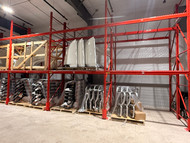
Pallet Racking Layout Mistakes and How to Avoid Them
Posted by Audrey Hood on Aug 20th 2026
Facility space can be hard to come by especially when you already have inventory filling up your current areas. Oftentimes, warehouses aren’t using their storage capacity to the best of their ability. Pallet rack layouts that haven’t been thoroughly thought out can be causing inefficient travel routes and may be underutilizing the available space.
Before adding onto your current setup or start plans to expand, it’s worth evaluating whether or not your current pallet racking setup is making the most of your space. Here are several common warehouse pallet rack layout mistakes that could be limiting your warehouse’s storage capacity.
Pallet Racking Layout Mistake #1: Not Maximizing Vertical Space
For some, it makes sense to fill up your floor space as much as possible, but oftentimes it can help to maximize your storage capacity by building up. Facilities that have used up much of their floor space might have low rack heights, empty air above the pallet racks, and gaps between beam levels.
Using your clear height is important because you can build up in your current space without taking up more floor space. Building up instead of out can create a high-density storage solution, allowing you to use the space you already have instead of expanding out more.
If there are gaps between beam levels, that means you’re storing air instead of what could be more inventory. Adding on beam levels will help you to eliminate this empty space, allowing you an extra level to store more material. Pallet racks are versatile, meaning rack modifications can be made to your current setup to ensure that is being used to the best of your ability. One note: before adding beam levels, check with your racking supplier to make sure your uprights can handle the additional capacity of another beam level.
Pallet Racking Layout Mistake #2: Aisles Are Wider Than Necessary
Oftentimes, facilities build in aisles that can accommodate personnel and machinery like forklifts. However, the aisles may be wider than they need to be. Being able to maneuver around aisles is important, but excessively wide aisles can be wasting valuable storage space.
Having a narrow aisle can offer the opportunity to have more storage space while still being able to access everything. This provides a balance between accessibility and storage density.

Pallet Racking Layout Mistake #3: The Wrong Type of Pallet Racking System
There are many types of pallet racking systems, each with their own unique benefits. It’s important to compare the different systems such as selective pallet racking, pushback racking, drive-in, pallet flow, and more to see which would benefit your workflow the best.
Depending on your specific needs and setup, for example, if you have frequent inventory rotation or need cold storage, certain systems will be benefit you more than others.
Pallet Racking Layout Mistake #4: Storing Quick and Slow-Moving Inventory Together
Inventory placement can make a difference in your workflow. When the items you have placed next to each other don’t match their demand, there can be congestion in warehouses and wasted space. It’s important to review SKUs and place items strategically to reduce forklift travel and make picking more efficient.
Having items that are picked frequently next to items that stay on the racking longer can create slowdowns.
Pallet Racking Layout Mistake #5: Not Planning for Growth
Your pallet racking layout should be fit to your current needs but also take into account how your needs may change and grow over time. Having a layout that can be adjusted when inventory grows or when new product lines are added makes it easier for you to grow in your operations. Flexible pallet racking systems can make it easier to reconfigure, add storage, or accommodate new inventory as your operations grow.
A setup that doesn’t account for the future can result in problems in the long term. As inventory increases, warehouses may not find themselves with the space needed. With congested aisles and the inability to expand, facilities can find themselves not knowing how to keep storing items.
When Should You Re-evaluate Your Pallet Rack Layout?
Signs that your pallet racking layout may need to be changed include:
- Pallets stored on the floor
- Full aisles
- Congestion and slowdowns
- Increased travel times
- No room for new inventory

Efficient Pallet Racking Layouts
Having an efficient pallet racking layout that supports your operational goals and allows for growth in your facility is important. This can allow you to unlock new storage capacities, improve workflow, and delay facility expansions.
Whether it’s using your clear height, adjusting beam levels, or reconfiguring aisle widths, a new layout can reveal opportunity to get more out of your existing footprint.
Not sure if your layout is cutting it? The ISS team can evaluate your current setup and identify opportunities to improve efficiency and maximize storage space. Reach out to us here, and we’ll get back to you soon or chat with one of us at 1-800-875-6201.
About the Author